






 Help Center
Updated on 2026-07-03
views
5min read
People are in the habit of capturing beautiful and important moments with their iPhones instead of traditional cameras, as smartphones have become an essential tool in daily life. However, you can suffer from photo loss at any time due to various reasons, such as accidental deletion, software updates, or malware intrusion.
You may wonder how to retrieve these deleted photos. We have brought you a complete, step-by-step logical guide to help you recover your photos, whether you have a backup or not. In this article, we will show you the top 5 ways to recover deleted photos from an iPhone.
Recover from the "Recently Deleted" Folder (Within 30 Days)
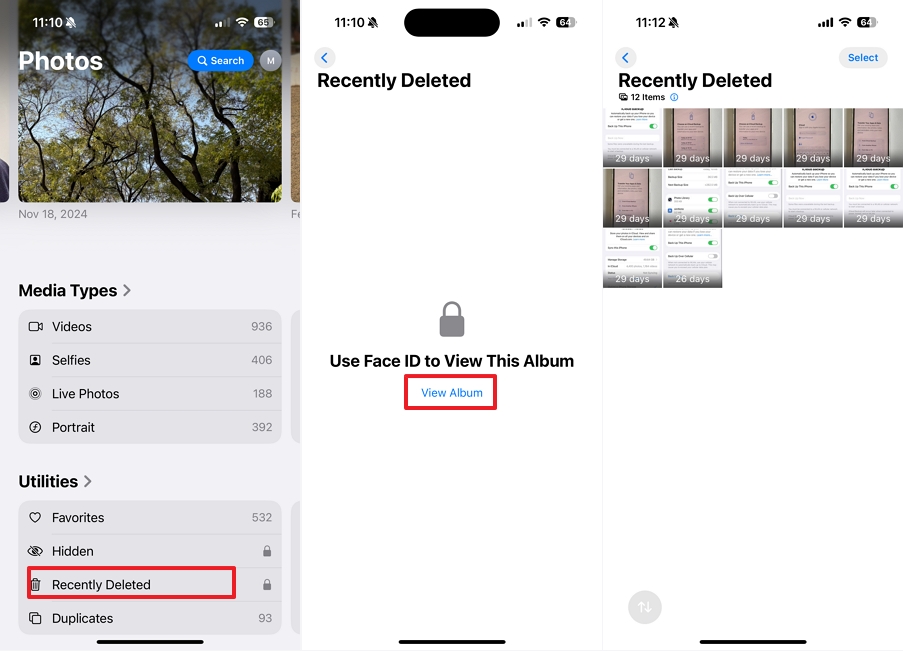
If a photo is accidentally deleted, the very first place to check is the iPhone's default Photos app. Pictures taken with the camera are saved here by default, and Apple provides a 30-day grace period to easily reverse any accidental deletions.
Step 1: Go to your iPhone home screen and select the Photos app.
Step 2: Tap on the "Albums" tab at the bottom and scroll down to locate the "Recently Deleted" folder.
Step 3: Open the folder. You will see the pictures scheduled for permanent deletion and how many days are left before they are removed completely (usually up to 30 days).
Step 4: Tap the picture you want to recover, then tap "Recover" at the bottom right. Confirm by tapping "Recover Photo", and the image will be restored to your main albums.
Check Third-Party Cloud Services (Google Photos, Dropbox, OneDrive)
If the 30-day window has passed or you emptied the "Recently Deleted" folder, check if you use third-party cloud services like Google Photos, Dropbox, or Microsoft OneDrive.
Unlike Apple's iCloud (which uses bidirectional synchronization), these third-party platforms generally function as one-way backup systems. Based on our test results, if you delete a photo on your iPhone's native "Photos" app, the copy stored on these external cloud servers remains untouched.
Therefore, as long as you have turned on the auto-backup feature for any of these three apps, the success rate of getting your photos back is almost 100%.
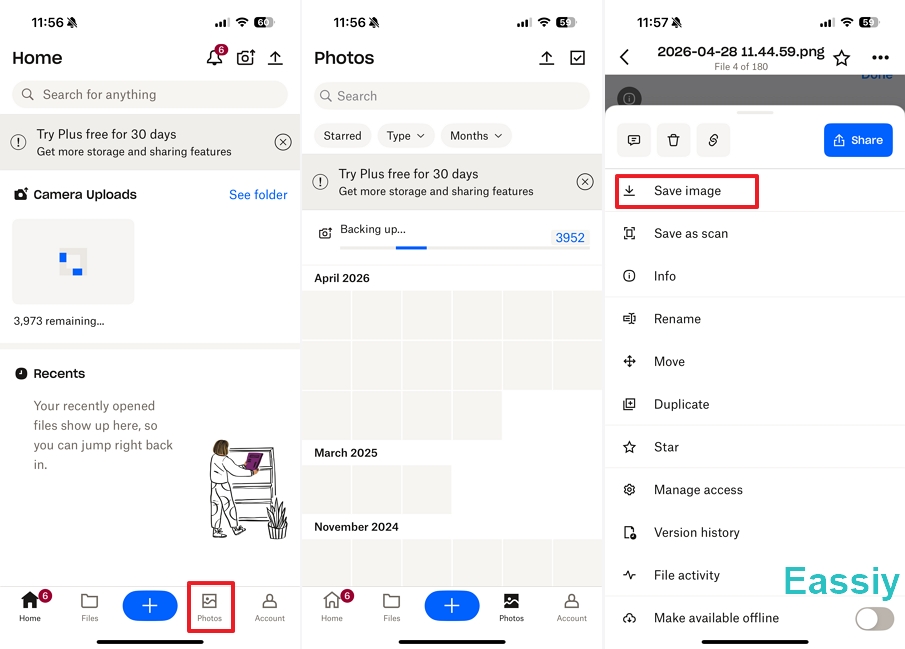
Here's how to find deleted photos on your iPhone from Dropbox:
- Step 1: Log in to Dropbox.com or open the Dropbox app.
- Step 2: Find the photos you deleted. You can browse your folders, filter by date range, or use the search bar.
- Step 3: Once you find the photos, tap the three-dot menu on the right and select "Save Image" to download the photos back to your iPhone.
Recover Deleted Photos from an Apple Backup (iTunes, Finder & iCloud)
If you don't use any third-party photo backup apps, but have previously backed up your iPhone using iTunes, Finder, or iCloud, you can attempt to recover your photos by restoring your iPhone from a previous backup. Please note that restoring from an iTunes, Finder or iCloud backup will overwrite all current data on your phone with the old data from the backup file.
Option 1: Restore from Computer Backup (Finder, Apple Devices App, or iTunes)
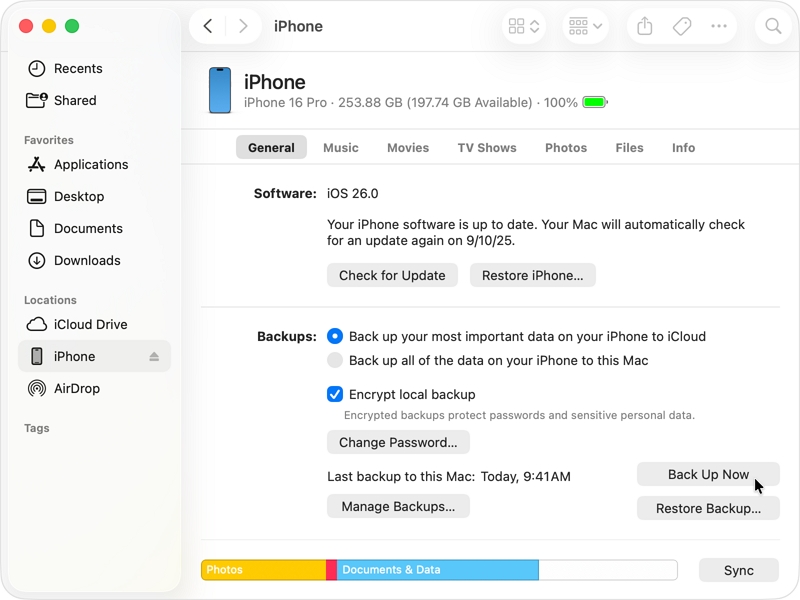
If you backed up your iPhone to a computer before the photos were deleted, those missing images are still safely stored within that backup. You can restore your iPhone to that previous state to get them back. The tool you use depends on your operating system:
- On Mac (macOS Catalina or later): Open Finder.
- On Windows (with the Apple Devices app): Open the Apple Devices app.
- On Windows (without Apple Device app) or older Mac (macOS Mojave or earlier): Open iTunes.
Step 1: Connect your iPhone to your computer using a USB cable.
Step 2: Select your iPhone when it appears in the Finder window, the Apple Devices app sidebar, or the iTunes window.
Step 3: In the General or Summary tab, click the "Restore Backup" button.
Step 4: Look at the date of each backup and pick the one most likely to contain your deleted photos. Click "Restore" and wait for the process to finish. (Note: If your backup is encrypted, you will need to enter your password.)
Option 2: Restore from iCloud Backup
Before you start this method, you need to erase all content and settings on your iOS device to perform the restoration.
Note: Before taking this drastic step, you must verify your iCloud settings. If you are wondering, does iCloud backup include photos? The answer depends entirely on your sync configurations. In our iOS 26 lab testing, we confirmed that if you already had the "iCloud Photos" toggle turned on, your deleted pictures are not included in the standard backup file. But when you log into the same Apple ID after the reset, your existing photos will simply sync back to your iPhone from the cloud.
Step 1: Go to “Settings > General > Transfer or Reset iPhone”.
Step 2: Tap “Erase All Content and Settings”.
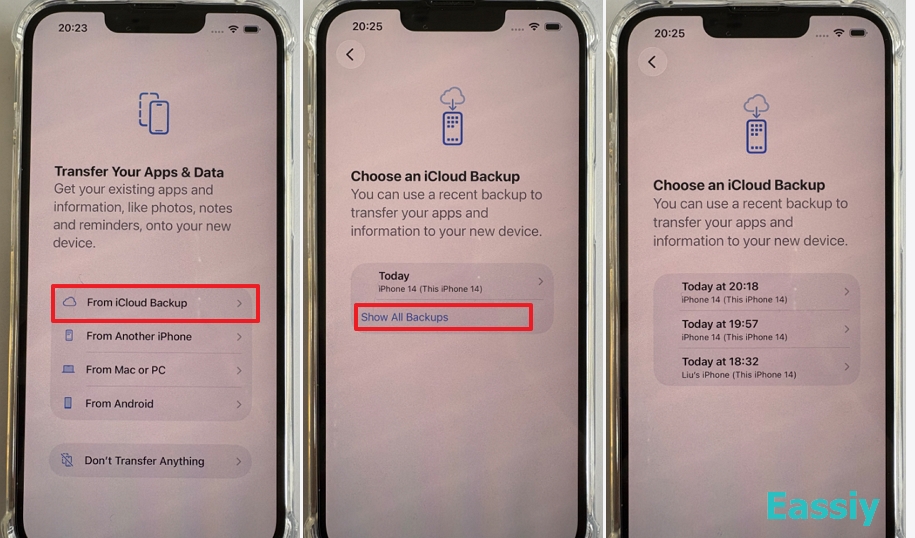
Step 3: After your iPhone restarts and reaches the Apps & Data screen, choose “Restore from iCloud Backup”.
Step 4: Sign in with your Apple ID and tap "Show All Backups".
Step 5: Select the most recent iCloud backup that contains your lost photos to begin the process.
Option 3 : Browse iCloud.com
It is crucial to understand the difference between iCloud Sync and iCloud Backup, which is why we have separated them into two distinct sections. While an iCloud Backup creates a complete, static snapshot of your device's data from a specific time, iCloud Sync continuously updates your files across all your Apple devices in real-time.
iCloud sync is a bit special, and the recovery success rate is generally lower because it is a bidirectional sync. This recovery approach is only viable if your iPhone was offline right before the deletion could sync. Since iCloud operates on a two-way synchronization model, any photo deleted while connected to the internet is instantly erased from Apple's servers too.
Once that sync happens, the image is permanently removed from both your device and iCloud. However, if the sync hasn't occurred, you can immediately log into iCloud.com to download the photos.
If you act quickly before the sync completes, follow these steps to recover your deleted photos via iCloud Web:
Step 1: Open a web browser on your computer and visit iCloud.com.
Step 2: Sign in using your Apple ID and password.
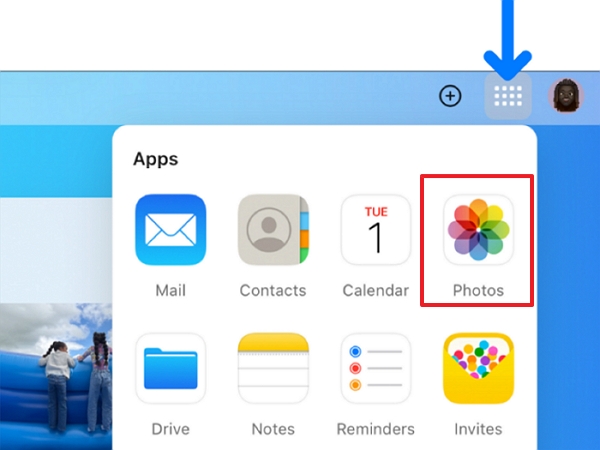
Step 3: From the main dashboard, select the "Photos" application. Check if your deleted photos are here.
Step 4: f not, navigate to the sidebar menu and click on the "Recently Deleted" album.
Step 5: Select the images you wish to retrieve and click the "Recover" button. The photos will be restored to your main iCloud albums and will automatically download back to your iPhone the next time it connects to the internet and syncs.
Use Eassiy iPhone Data Recovery (No Backup Required)
What should you do if you don't have any backups prepared and the photos are permanently deleted? In this scenario, you will need a professional third-party tool capable of extracting residual data directly from the device's storage.
We tested Eassiy iPhone Data Recovery in our lab, and it has proven to be one of the most capable tools for recovering permanently deleted photos directly from your iOS device without any backup. It requires no technical skills and supports over 36 file types, making it versatile enough to handle almost any data loss situation.
Features:
- Provides 3 different modes to retrieve lost data on an iPhone.
- Recovers 36+ file types (including photos, WhatsApp, Line, messages) without secondary data loss.
- Scans over 1,000 deleted photos in seconds.
- Delivers the highest photo recovery rate among similar industry products.
Steps to recover permanently deleted photos without backup:
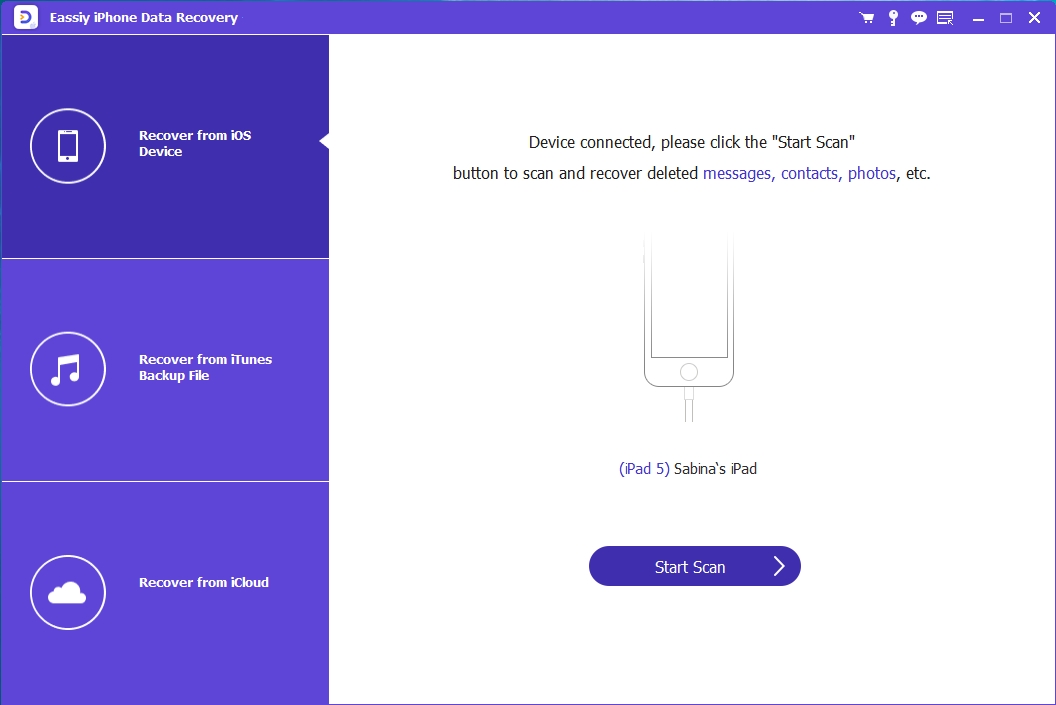
Step 1: Download and install the Eassiy iPhone Data Recovery software. Connect your iPhone to your computer using a USB cable and launch the program.
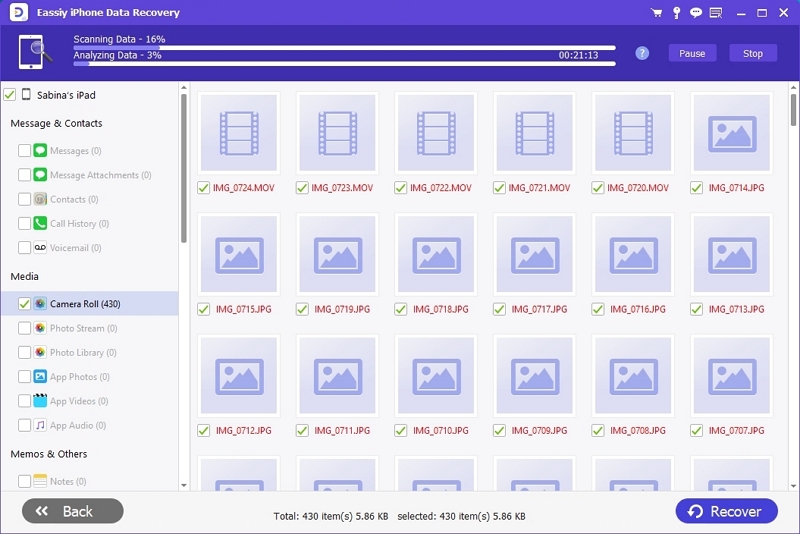
Step 2: Click the “Start Scan” button. The software will perform a deep scan of your iPhone for permanently deleted data. (Scan time depends on your storage usage).
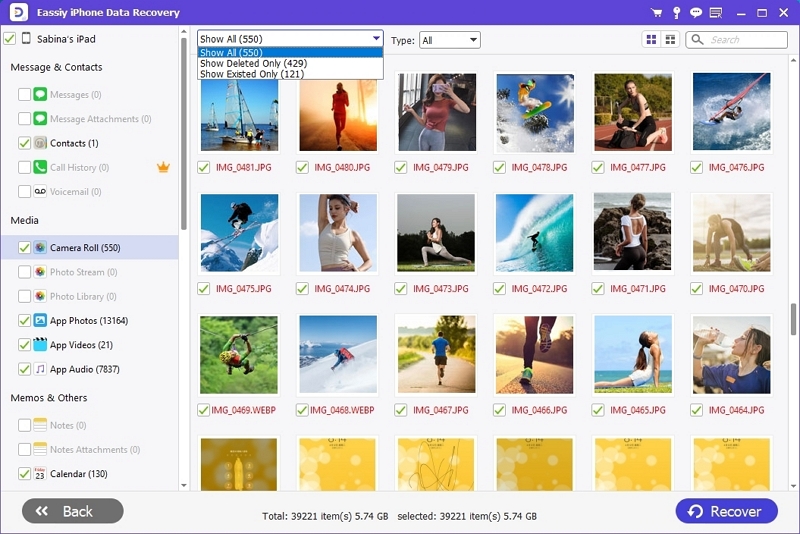
Step 3: After scanning, both lost and existing images will be displayed. Toggle on the "Only display the deleted items" button to quickly locate your missing files.
Step 4: Check the boxes next to the photos you need, then click the "Recover" button at the bottom right corner to save them safely to your computer.
Recover Deleted Photos from Messaging Apps
If all the above methods fail, there is one last workaround. Think about whether you have shared the deleted photos via any Instant Messaging (IM) apps such as WhatsApp, Viber, or iMessage.
Even if a photo is permanently deleted from your camera roll, a copy might still exist on the messaging app's servers or within the chat logs. While you might lose some of the original quality due to image compression, it is certainly better than losing the photo altogether.
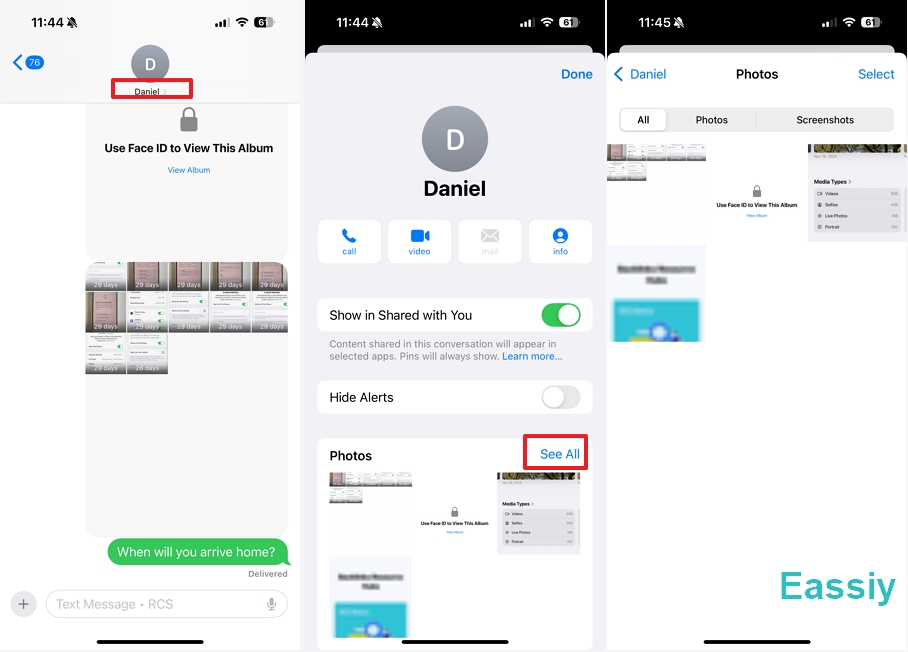
Apps like iPhone Messages, WhatsApp and Viber allow you to view all shared media within a specific contact's chat info. Here's how to find photos sent via iPhone messages in an individual conversation:
- Step 1: Open the Messages app and open a conversation.
- Step 2: Tap the contact's name or photo at the top of the screen.
- Step 3: Scroll down to find the Photos section.
- Step 4: Tap "See All" to view all images in a grid format.
FAQs
1. Where can I find recently deleted photos on iPhone?
The first place to check is the “Recently Deleted” folder. Open the “Photos” app, tap on “Albums”, and scroll down to the bottom to find the “Recently Deleted” section. Select the pictures you wish to restore and tap the “Recover” button.
2. Can I recover permanently deleted photos from my iPhone for free?
Whenever you realize data has been deleted, stop using the phone immediately to prevent new data from overwriting the invisible deleted files. If you have a backup on iCloud or iTunes, you can restore them for free. Otherwise, using a professional third-party data recovery tool is the most secure way to scan the device directly.
3. Are deleted photos on iPhone really deleted?
When you initially delete photos from your iPhone, they are not permanently erased right away. They are moved to the "Recently Deleted" album, where they have a 30-day grace period to be easily restored. After 30 days, they are permanently removed, at which point you will need specialized recovery software to extract them.
4. Do the photos stay on iCloud if deleted from iPhone?
If you have iCloud Photos synchronization turned on, deleting a photo on your iPhone will simultaneously delete it from iCloud. However, if your phone was offline when the deletion happened, or if you previously created a hard iCloud Backup (rather than just sync), the photos may still be recoverable from the cloud.
Conclusion:
iPhone photo recovery can be easy if you apply the proper method. As outlined in this guide, you should always start with the Recently Deleted folder and third-party cloud apps like Google Photos. If you have an Apple backup available, restoring via iTunes or iCloud is a solid option, provided you don't mind overwriting your current data. However, if no backup file is available, we highly recommend using Eassiy iPhone Data Recovery. It securely accesses your device's internal memory to retrieve lost files, supporting over 36 file types with an incredibly user-friendly process.